

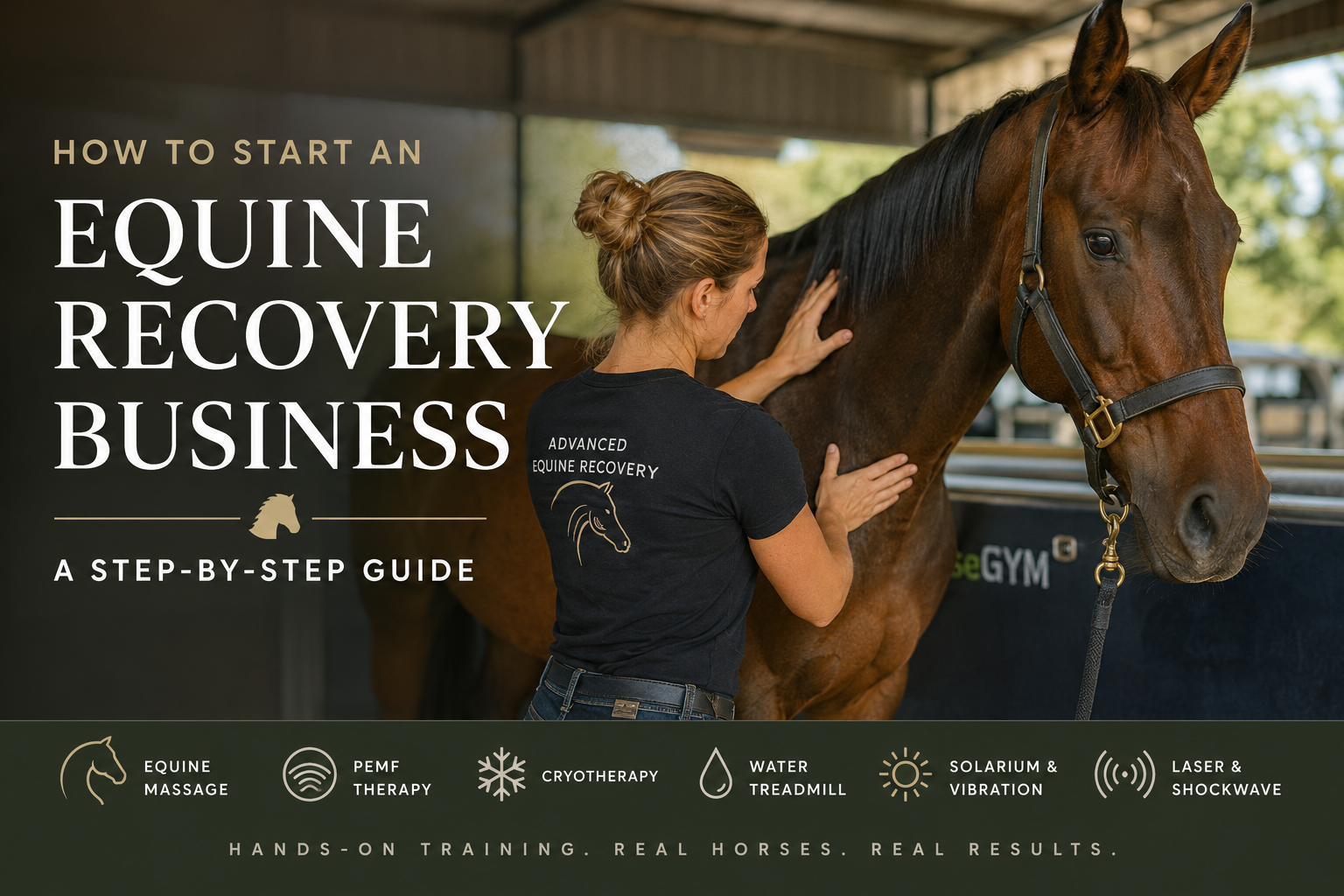
How to Start an Equine Recovery Business
Learn how to start an equine recovery business, choose services, complete hands-on training, price packages, work with veterinarians, and attract horse owners.
Equine Recovery Business Step-by-Step Guide
Starting an equine recovery business allows you to combine your love of horses with practical services that support comfort, movement, conditioning, performance, and recovery.
An equine recovery business may offer services such as equine massage, PEMF, cryotherapy, water treadmill sessions, solarium and vibration sessions, and other rehabilitation technologies used as part of a horse’s veterinarian-directed recovery or performance-maintenance program.
But owning a few pieces of equipment is not enough.
This guide explains how to start an equine recovery business from the ground up.
To build a professional equine recovery business, you need hands-on training, safe operating procedures, an understanding of equine anatomy and behavior, appropriate insurance, clear service boundaries, and strong relationships with horse owners, trainers, and veterinarians.
People who want direct experience working on horses and learning professional recovery equipment can explore Advanced Equine Recovery’s hands-on equine massage and rehabilitation certification program in Oklahoma.
What Is an Equine Recovery Business?
An equine recovery business provides supportive services intended to help horses relax, move comfortably, maintain conditioning, and recover appropriately following training, competition, travel, time off, or veterinary care.
Depending on the practitioner’s training, equipment, location, and legal scope of practice, services may include:
Equine massage and bodywork
Pulsed electromagnetic field therapy, commonly called PEMF
Cryotherapy and cold applications
Equine water treadmill sessions
Equine cold water spa sessions
Solarium and vibration therapy
Class IV laser applications
Radial shockwave applications
Post-performance recovery sessions
Conditioning and return-to-work support
Mobile recovery services at barns and horse shows
Mobile, Facility Based or Hybrid Equine Business
Some businesses operate entirely from a mobile trailer or vehicle.
Others are located inside training barns, veterinary facilities, boarding operations, or dedicated equine rehabilitation centers.
A hybrid business may provide advanced equipment at a home facility while also offering massage, PEMF, cryotherapy, and other portable services at clients’ barns.
Step 1: Choose Your Equine Recovery Business Model
Mobile Equine Recovery Business
A mobile business travels to private barns, training facilities, competitions, and horse owners’ properties.
Mobile services can have lower startup costs because you do not immediately need a dedicated facility. However, you will need reliable transportation, portable equipment, organized scheduling, and clear travel policies.
Common mobile services may include:
Equine massage
PEMF sessions
Portable cryotherapy
Recovery sessions after competition
Muscle relaxation and performance-maintenance sessions
Services performed as part of a veterinarian’s rehabilitation plan
Mobile work can be a practical starting point for someone who already has relationships with local trainers and horse owners.
Facility-Based Equine Recovery Business
A facility-based operation allows you to use equipment that cannot be transported easily, including an equine water treadmill, cold water spa, solarium, vibration floor, or larger rehabilitation systems.
A professional facility may also provide:
Short-term rehabilitation boarding
Conditioning programs
Post-surgical support under veterinary direction
Return-to-work programs
Haul-in appointments
Weekly or monthly recovery packages
This model requires more property, equipment, labor, safety planning, maintenance, and insurance.
Hybrid Equine Recovery Business
A hybrid business combines mobile services with a physical recovery facility.
This model can create several income streams. Clients can schedule portable services at their barn while horses needing water treadmill sessions, more intensive conditioning, or multiple modalities can haul into the facility.
Step 2: Decide Which Horses and Owners You Want to Serve
Trying to serve every horse owner can make your marketing unclear.
Choose the group of horses and clients you understand best.
Possible markets include:
Reining and reined cow horse competitors
Barrel racing and rodeo horses
Hunter, jumper, and dressage horses
Racehorses
Trail and endurance horses
Senior horses
Horses returning to work after time off
Horses following veterinarian-directed rehabilitation plans
Boarding barns and training programs
Owners interested in proactive performance maintenance
Your target market will influence your services, equipment, pricing, schedule, and marketing.
For example, a mobile practitioner serving show barns may focus on massage, PEMF, cryotherapy, and post-performance recovery. A facility working with horses returning from injury may invest more heavily in water treadmill, cold water spa, and controlled conditioning services.
Step 3: Complete Hands-On Equine Recovery Training
Online education can help you learn terminology and basic theory, but it cannot replace working with real horses. You need to experience how different horses react to equipment, touch, pressure, movement, noise, water, confined spaces, and unfamiliar sensations.
Handle horses safely during recovery sessions
Prepare a horse for each modality
Position equipment correctly
Recognize stress, discomfort, or behavioral changes
Observe how horses respond during sessions
Maintain and clean equipment
Document services accurately
Recognize situations that require veterinary referral
Stay within your legal and professional scope
Communicate with owners, trainers, and veterinarians
Hands-on equine recovery training should teach you how to:
Good training should explain not only how equipment works, but also why a modality may be selected and when it may not be appropriate.
Advanced Equine Recovery offers a three-day, small-group program where students work directly with horses and receive supervised exposure to several professional recovery modalities.
The hands-on equine rehabilitation certification is designed for beginners, horse owners, barn managers, trainers, veterinary technicians, and individuals interested in starting a mobile or facility-based equine recovery business.
Step 4: Learn the Major Equine Recovery Modalities
You do not have to purchase every piece of equipment immediately. You should, however, understand the major services used in modern equine recovery programs.
Equine Massage and Bodywork
Equine massage uses intentional touch and pressure to support relaxation, circulation, body awareness, and comfortable movement.
A trained practitioner should understand equine anatomy, body language, tissue response, pressure, positioning, and reasons to stop a session or refer the horse to a veterinarian.
Massage is also one of the most practical services for a new mobile equine recovery business because it does not require large equipment.
Cryotherapy
Cryotherapy uses controlled cold applications to support recovery and inflammation management.
Depending on the system, cryotherapy may be used as part of post-performance care or a veterinarian-directed recovery plan. Practitioners must know how to protect the horse’s skin, operate the equipment correctly, and monitor the horse throughout the application.
Class IV Laser
Class IV laser systems deliver concentrated light energy to targeted areas.
Laser equipment requires proper training, protective eyewear, accurate positioning, understanding of equipment settings, and close attention to legal requirements. In some locations or circumstances, laser applications may need to be performed by or under the direction of a veterinarian.
Equine Somatic Massage
Somatic massage focuses on the relationship between the horse’s nervous system, fascia, movement patterns, and stored tension.
The practitioner pays close attention to subtle changes in breathing, posture, muscle tone, facial expression, movement, and relaxation.
Equine Water Treadmill Therapy
An equine water treadmill allows a horse to walk in controlled water depth and at a controlled speed.
Water provides resistance while buoyancy changes the amount of weight placed on the horse’s limbs. Water treadmill programs may be used for conditioning, strengthening, movement, and rehabilitation support.
Safe operation requires more than turning on the machine. Practitioners must learn horse loading, emergency procedures, water depth selection, speed selection, session progression, equipment sanitation, and behavioral monitoring.
Radial Shockwave
Radial shockwave systems use pressure waves applied to targeted areas.
Because shockwave is frequently associated with diagnosed musculoskeletal conditions, practitioners must understand their legal scope and work closely with veterinarians. It should never be used as a substitute for veterinary diagnosis.
PEMF Therapy
Pulsed electromagnetic field therapy is commonly used by equine professionals to support relaxation, circulation, and general recovery.
Portable PEMF systems can work well in a mobile business, but practitioners still need equipment-specific training, safe handling procedures, client screening, and an understanding of contraindications.
Equine Cold Water Spa
A cold water spa surrounds the horse’s lower limbs with cold, moving water.
Cold water spas are commonly incorporated into equine performance and recovery programs. Proper training is necessary to load horses safely, control water temperature, maintain sanitation, and recognize horses that should not use the equipment.
Equine Solarium and Vibration Therapy
An equine solarium may combine infrared heat with a gently shifting vibration floor.
These systems may be incorporated into warm-up, relaxation, circulation, and recovery routines. Horses must be introduced carefully and monitored for stress, balance, and comfort.
Step 5: Understand Your Legal Scope of Practice
Before accepting clients, research the laws in every state where you plan to work.
Rules involving animal massage, rehabilitation, laser, shockwave, PEMF, and the use of terms such as “therapy,” “treatment,” and “rehabilitation” vary by location.
Your certification does not replace a veterinary license or allow you to diagnose an injury or medical condition.
A responsible equine recovery practitioner should not:
Diagnose lameness or disease
Promise to cure an injury
Change a veterinarian’s treatment plan
Tell an owner to discontinue veterinary care
Perform services that are restricted to veterinarians in that state
Present supportive recovery services as a replacement for veterinary medicine
Build referral procedures into your business from the beginning. When a horse presents with unexplained heat, swelling, significant pain, acute lameness, neurological signs, open wounds, fever, or sudden behavioral changes, stop and refer the owner to a veterinarian.
Veterinary and trainer relationships can become one of the strongest foundations of your business.
Your goal is not to compete with veterinarians. Your goal is to become a reliable professional who communicates clearly, follows instructions, documents sessions, recognizes limitations, and refers horses appropriately.
Introduce yourself to local veterinarians and explain:
Your training and certification
Which services you provide
Which equipment you use
What documentation you maintain
How you handle veterinary referrals
That you do not diagnose or alter medical treatment plans
Trainers can also become valuable referral partners because they observe horses daily and frequently notice changes in movement, performance, attitude, or recovery.
Professionalism earns more referrals than exaggerated claims.
Step 6: Build Relationships With Equine Veterinarians and Trainers
A mobile practitioner may begin with:
Massage and bodywork supplies
A portable PEMF system
Portable cryotherapy equipment
Red light or other permitted supportive equipment
Cleaning and sanitation supplies
Secure equipment storage
Recordkeeping software or forms
Step 7: Select Equipment Based on Demand
Larger investments may come later:
Equine water treadmill
Cold water spa
Class IV laser
Radial shockwave system
Solarium
Vibration floor
Dedicated treatment stocks or work areas
Before purchasing equipment, calculate:
The total purchase price
Financing costs
Insurance costs
Training requirements
Maintenance and repair expenses
Consumable supplies
The number of monthly sessions needed to cover the expense
Whether your local market will consistently pay for the service
Expensive equipment does not automatically create a successful business. Client trust, safe practices, dependable scheduling, and measurable service demand matter more.
One of the most expensive mistakes new practitioners make is buying equipment before confirming local demand.
Begin with services you can perform safely, confidently, and consistently.
Step 8: Create Professional Forms and Safety Protocols
Every horse and every session should be documented.
Your business should have:
Client intake form
Horse history form
Veterinarian information
Emergency contact information
Service agreement
Liability waiver
Equine activity warning
Veterinary referral policy
Session notes
Before-and-after observations
Equipment cleaning logs
Maintenance logs
Incident report form
Photo and video release
Cancellation policy
Travel policy
Your notes should describe what you observed and what services you provided without making a veterinary diagnosis.
For example, write that the owner reported stiffness after a competition rather than stating that the horse has a specific injury unless that diagnosis came from a veterinarian.
Digital Documentation: Choose Your Equine Rehab Software
As your business grows, relying on paper waivers, printed intake forms, scattered text messages, or unorganized notes makes it difficult to track a horse’s long-term physical progress and maintain professional records.
Integrating software built specifically for equine bodyworkers and rehabilitation practitioners streamlines your workflow, protects your business liability, and elevates the experience you deliver to owners and veterinarians.
Why Specialized Software Matters for Your Equine Business
Standard business apps or paper forms rarely account for horse-specific reporting needs or legal compliance. A dedicated equine rehabilitation software helps you:
Digital Waivers & Agreements: Easily send and store signed client intake forms, liability waivers, veterinary referral policies, and service agreements digitally before your first appointment.
Eliminate Scattered Text Threads: Replace disorganized SMS threads with clear, structured client reports sent directly to horse owners and trainers after every session.
Standardize Session Documentation: Quickly log focal muscle tension, palpation findings, equipment settings, and movement observations using consistent, repeatable templates.
Track Long-Term Physical Progress: Document baseline observations and track changes across multiple sessions, water treadmill workouts, or bodywork appointments.
Strengthen Veterinary Communication: Generate professional summary reports that horse owners can share directly with their attending veterinarian to support collaborative care.
Centralize Business Records: Keep signed liability forms, veterinarian contact details, horse histories, and session notes securely organized in one platform.
The Advanced Equine Recovery App
Built by bodywork and rehabilitation practitioners for real-world barn environments, the Advanced Equine Recovery App is designed to simplify documentation and form collection without slowing down your hands-on work.
Whether you operate a mobile bodywork business or manage a full-service residential recovery facility, our app replaces paper clutter and lost waivers with fast, digital client reporting and form management.
Explore the Platform: Learn how our software can streamline your documentation, manage digital waivers, and support your practice by visiting our Equine Bodywork & Rehabilitation Software Page.
Include:
Travel time
Fuel and vehicle expenses
Equipment cost
Equipment maintenance
Insurance
Scheduling and communication
Cleaning and sanitation
Continuing education
Facility expenses
Employee labor
Taxes
Marketing
Recordkeeping
You can offer individual appointments, but packages often create more consistent revenue.
Step 9: Set Your Prices and Create Service Packages
Possible offers include:
Single massage or PEMF session
Mobile recovery bundle
Post-show recovery session
Weekly performance-maintenance package
Monthly barn package
Multiple-horse trainer package
Water treadmill conditioning package
Haul-in recovery package
Rehabilitation boarding package
Customized veterinarian-directed program
Do not choose prices simply because another practitioner charges a certain amount. Calculate what it costs to operate your own business and what your market can reasonably support.
Your pricing must cover more than the time you spend touching the horse.
Create content that answers questions such as:
What does an equine recovery specialist do?
How does an equine water treadmill work?
What is the difference between equine massage and PEMF?
Can I start a mobile equine therapy business?
What happens during a horse recovery session?
When should a horse be referred to a veterinarian?
How do performance horses recover after competition?
What training is needed to operate equine rehabilitation equipment?
Step 10: Market Your Equine Recovery Business
Use original photos and videos of:
You working with horses
Safe equipment setup
Horses calmly using the water treadmill
Massage techniques
Equipment cleaning and preparation
Your treatment area
Training and continuing education
Behind-the-scenes daily operations
Include your city, state, and service area throughout your website where it reads naturally. This helps local horse owners understand where you work.
Your website should have separate pages for your major services, a clear contact page, an About page showing your real experience, client reviews, and educational articles that answer common horse-owner questions.
Can You Start an Equine Recovery Business Without a Facility?
Yes. Many practitioners begin with a mobile equine massage, bodywork, PEMF, or recovery-support business.
A mobile model allows you to build relationships and determine which services are in demand before making a large facility investment.
You will still need hands-on education, business registration, insurance, professional forms, safe equipment, reliable transportation, and a clear understanding of your state’s rules.
Frequently Asked Questions
How Much Does It Cost to Start an Equine Recovery Business?
Startup costs vary significantly.
A massage-focused mobile business may require relatively limited equipment. A full-service rehabilitation facility with a water treadmill, cold water spa, laser, shockwave, solarium, specialized flooring, and rehabilitation stalls can require a substantial investment.
Start by building a realistic business plan instead of trying to recreate a large rehabilitation center immediately.
Choose one or two services, gain experience, develop referral relationships, and add equipment when client demand supports it.
Do You Need Equine Rehabilitation Certification?
Training and certification help demonstrate that you have completed structured education, but the value of a program depends on what it actually teaches.
Look for training that includes:
Real horses
Supervised practice
Safety procedures
Equine body language
Equipment setup
Contraindications and referral situations
Cleaning and maintenance
Documentation
Business considerations
Opportunities to ask questions in a small group
A certificate alone does not create competence. The strongest programs combine education, hands-on repetition, instructor supervision, and continued practice after the course.
Start With Hands-On Equine Recovery Training
A successful equine recovery business is built on more than a love of horses.You need the ability to handle horses safely, operate equipment correctly, recognize when a horse needs veterinary care, communicate professionally, and provide a dependable experience for owners and trainers.
Advanced Equine Recovery provides hands-on equine massage and rehabilitation training at Rein Maker Ranch in Wayne, Oklahoma. Students work with real horses while learning about equine massage, PEMF, cryotherapy, Class IV laser, radial shockwave, water treadmill therapy, cold water spa, and solarium and vibration systems.
The small-group program is designed for horse owners, trainers, barn managers, veterinary technicians, equine professionals, and individuals interested in building a mobile or facility-based recovery business.
No previous experience with rehabilitation equipment is required. View upcoming hands-on equine rehabilitation certification dates and program information.